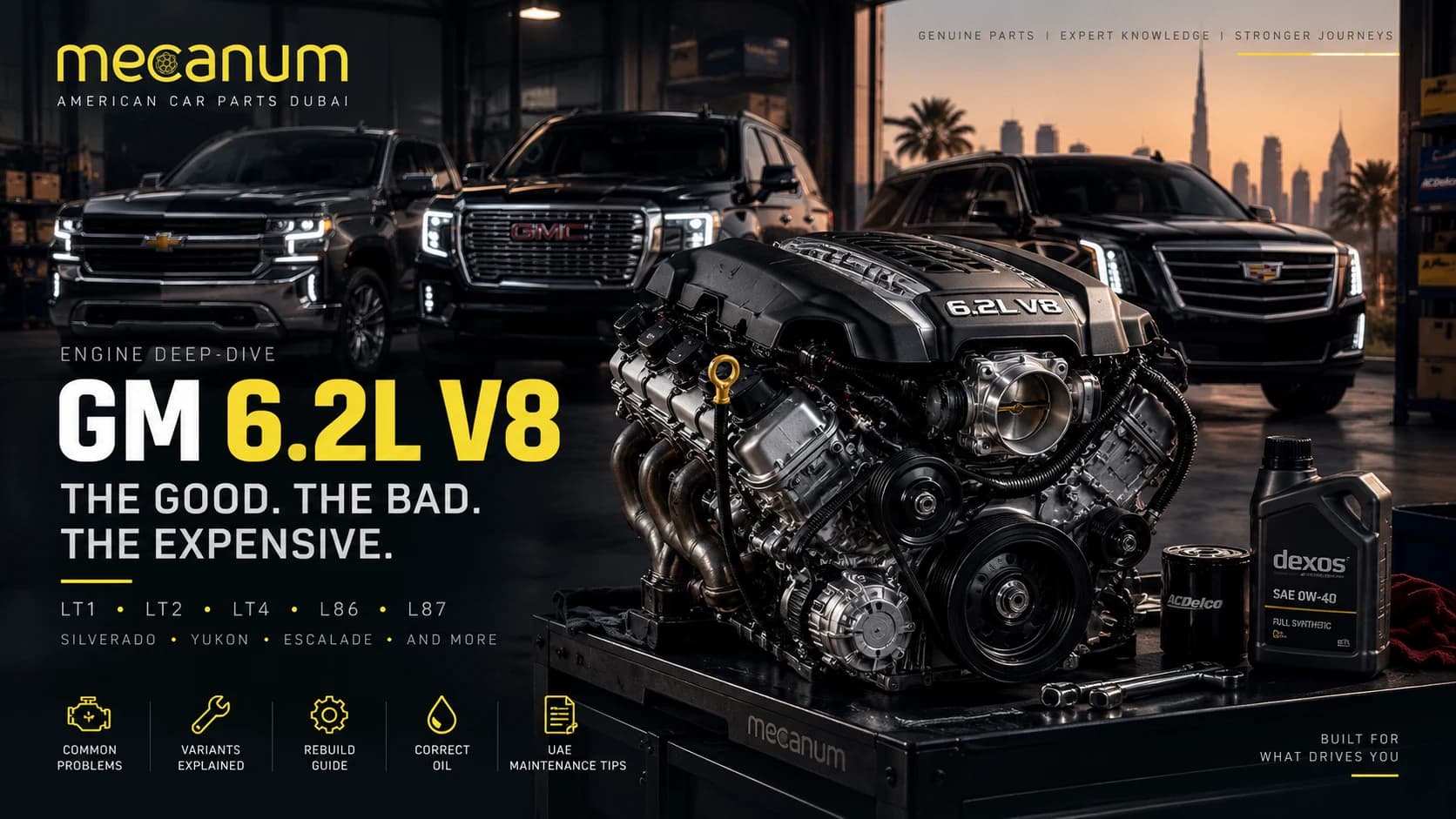
GM 6.2L V8 Engine Guide: Problems, LT1, LT2, LT4 & L87 Explained
Published
There are engines that do their job and disappear into the background. Then there is the GM 6.2L V8 — an engine that enthusiasts worship, workshop owners fear, and owners of Chevrolet Silverados, GMC Yukons, and Cadillac Escalades have very strong feelings about, usually depending on whether theirs has ever needed a lifter replacement.
This engine is genuinely brilliant. It is also, under specific conditions, capable of failing in ways that are expensive, frustrating, and — according to a 2025 NHTSA recall covering over 700,000 vehicles — sometimes related to manufacturing defects that GM knew about.
Before anything else, let us be clear about something: the 6.2L's most documented problems are not random bad luck. They follow a pattern, they are concentrated in specific systems, and they are significantly worsened by the conditions that UAE owners drive in every day.
Fault 1: AFM Lifter Collapse — The Big One
The Active Fuel Management system — known as AFM in older trucks, DFM (Dynamic Fuel Management) in newer ones — was designed to improve fuel economy by deactivating cylinders when the engine does not need full power. In theory it is clever. In practice, for the 6.2L, it has been the source of the engine's most serious and most expensive reliability problem.
The AFM uses special collapsible lifters that switch cylinders on and off as needed. These lifters rely on precise, clean oil pressure to function correctly. When oil is even slightly degraded, or when the oil change intervals are stretched, or when the engine is subjected to extreme heat that accelerates oil breakdown — the lifters collapse. A collapsed lifter bends a pushrod. A bent pushrod damages the camshaft. By the time the owner hears the telltale tick or knock, the damage is often already into thousands of dirhams of repair territory.
One owner reported taking a 2020 Silverado LTZ 6.2L to the dealer with exactly this problem — collapsed lifter, bent pushrod, damaged camshaft, and significant carbon buildup — at low mileage. The repair quote was $4,100. A second owner reported the same failure on a 2021 Trailboss 6.2L with only 17,000 miles on it.
Source: chevytrucks.org — EcoTec3 6.2L Engine Problems
The AFM lifter problem is not isolated. In early 2026, multiple federal cases in the United States were consolidated into a single class action in the US District Court for the Eastern District of Michigan. The 389-page complaint alleged that GM was aware of elevated failure rates as early as 2021 and continued marketing these vehicles as dependable.
NHTSA Recall 25V-274 — What You Need to Know
In 2025, GM issued a safety recall covering 2021–2024 Cadillac Escalade and Escalade ESV, Chevrolet Silverado 1500, Suburban, and Tahoe, and GMC Sierra 1500, Yukon, and Yukon XL vehicles equipped with the 6.2L V8 L87 engine. The recall covered over 700,000 vehicles globally, citing manufacturing defects in the connecting rods and/or crankshaft that could lead to loss of propulsion or complete engine failure. Affected vehicles in the UAE that fall within the recalled production window should be checked immediately.
Source: NHTSA Recall Report 25V-274, US Department of Transportation
Fault 2: Carbon Buildup on Intake Valves
The 6.2L uses Gasoline Direct Injection (GDI) — fuel is sprayed directly into the combustion chamber rather than into the intake port. This is more efficient and produces more power, but it has a side effect: the fuel spray never washes over the back of the intake valves, so oil vapour from the PCV (Positive Crankcase Ventilation) system bakes onto the hot valve surfaces and accumulates as carbon deposits over time.
The symptoms are progressive. First a slight rough idle. Then hesitation on acceleration. Then misfires. By the time most owners notice something is wrong, the carbon buildup is significant enough to require a professional cleaning — typically walnut blasting, where crushed walnut shells are blasted through the intake ports to remove deposits without damaging the metal.
In UAE driving conditions — frequent short trips in stop-start traffic, high ambient temperatures accelerating oil vapour production — this problem develops faster than in temperate climates. An oil catch can installed on the PCV line is one of the most cost-effective preventive measures available.
Carbon cleaning costs and intervals
Professional walnut blasting of the intake valves typically costs AED 800 to AED 1,800 in UAE workshops depending on the vehicle and the level of buildup. For UAE driving conditions, a cleaning interval of every 50,000 to 60,000 km is a reasonable precaution rather than waiting for symptoms. An oil catch can costs AED 400 to AED 800 and significantly slows the rate of buildup.
Fault 3: Excessive Oil Consumption and Low Oil Pressure
The AFM system controls oil flow to deactivate cylinders using solenoids and passages. When these components degrade or fail, oil can leak into the combustion chamber and burn off. GM has stated that consumption of up to one quart per 2,000 miles is within acceptable limits for this engine — a threshold that many owners and independent mechanics consider far too high for a modern engine.
The practical consequences in the UAE: in extreme heat, oil consumption accelerates. An owner who is not checking their oil level between the recommended service intervals — which many are not — can unknowingly run the engine low, triggering exactly the kind of oil starvation that causes the AFM lifters to fail. The two problems feed each other.
Low oil pressure warnings are also a documented symptom, caused by clogged oil passages, worn oil pump components, or degraded oil that has lost viscosity under heat. If the low oil pressure warning appears on a UAE-spec Yukon or Escalade, it should be treated as an emergency — not something to monitor for another few days.
The 6.2L's AFM system, its direct injection architecture, and its oil sensitivity form a triangle of vulnerabilities. In moderate climates with disciplined maintenance, each is manageable. In UAE summer heat with stretched service intervals, all three compound each other.
Act 2: Know Your Engine — LT1 vs LT2 vs LT4 (and the Truck Variants)
The GM 6.2L is not a single engine. It is a family of engines sharing the same displacement and the same Gen V Small Block architecture, but with significant differences in application, internals, and performance. Here is the complete picture — particularly relevant for UAE owners who may not know which variant is under their bonnet.
LT1 — 6.2L Naturally Aspirated | Corvette C7 & Camaro SS
Horsepower
455–460 hp (with optional exhaust)
Torque
460 lb-ft (623 Nm)
Compression
11.5:1
Fuel system
Direct injection (GDI)
Key feature
Variable valve timing, Active Fuel Management (AFM)
Vehicles
2014–2019 Chevrolet Corvette C7 Stingray, 2016–2024 Chevrolet Camaro SS/LT1
UAE relevance
High — Camaro SS is common in UAE performance market
The LT1 is the foundation of the Gen V small block family. According to GM Authority, it represented the most significant redesign in the small block's nearly 60-year history at its 2014 debut. Its AFM system is the same architecture responsible for the lifter problems documented above — and is the variant most likely to be affected in UAE performance cars.
LT2 — 6.2L Naturally Aspirated | Corvette C8
Horsepower
495 hp
Torque
470 lb-ft (637 Nm)
Compression
11.5:1
Fuel system
Direct injection (GDI)
Key difference from LT1
Dry-sump oiling with three multistage pumps, larger oil cooler, improved intake manifold, equal-length exhaust runners
Vehicles
2020–present Chevrolet Corvette C8 Stingray
UAE relevance
Medium — C8 Corvette is present in UAE but less common than C7
The LT2 is the LT1 refined for the C8 Corvette's mid-engine layout. The most significant upgrade is the dry-sump oiling system — three multistage pumps replacing the single pump of the LT1. This addresses one of the LT1's oil management weaknesses and makes the LT2 inherently more robust under high-performance conditions. It is a better engine than the LT1 by most measures.
LT4 — 6.2L Supercharged | Corvette Z06, Camaro ZL1, Escalade-V
Horsepower
650 hp (682 hp in Escalade-V tune)
Torque
650 lb-ft (881 Nm)
Compression
10:1 (lower to accommodate boost)
Supercharger
1.7L Eaton TVS Roots-type, air-to-liquid intercooled
Block
Rotocast A356-T6 aluminium cylinder heads, forged pistons, titanium intake valves
Oiling
Dry-sump (Corvette Z06), wet-sump (Camaro ZL1, Cadillac models)
Vehicles
2015–2019 Corvette C7 Z06, Camaro ZL1, Cadillac CTS-V, Cadillac Escalade-V
UAE relevance
Very high — Escalade-V is a flagship UAE vehicle; Camaro ZL1 has strong UAE presence
The LT4 is the supercharged variant — built on the same Gen V architecture as the LT1 but with significantly reinforced internals to handle the boost from the Eaton blower. The compression ratio drops to 10:1 from the LT1's 11.5:1 to accommodate the forced induction. Forged pistons replace the cast units. The cylinder heads use Rotocast A356-T6 aluminium for better strength and heat dissipation.
For UAE Escalade-V owners in particular, this is the engine you are running — 682 horsepower, hand-built, and requiring the strictest oil and maintenance discipline of any engine in this guide. The LT4 specification calls for dexos R certified 0W-40 oil, and the consequences of running the wrong lubricant are proportionally more severe than in any of the naturally aspirated variants.
L86 / L87 — 6.2L Truck Variants | Silverado, Yukon, Escalade, Tahoe
Horsepower
420 hp (L87 with DFM)
Torque
460 lb-ft (623 Nm)
Key difference
Tuned for torque and utility rather than peak horsepower
L86 vs L87
L87 adds Dynamic Fuel Management (DFM) — an evolution of AFM with more deactivation modes — and improved cooling
Vehicles
Chevrolet Silverado 1500, Chevrolet Tahoe, Chevrolet Suburban, GMC Sierra 1500, GMC Yukon / Yukon XL Denali, Cadillac Escalade / Escalade ESV
UAE relevance
Extremely high — this is the 6.2L most UAE owners are running
Recall affected
YES — NHTSA Recall 25V-274 covers 2021–2024 L87 engines
The L86 and L87 are the 6.2L variants that the majority of UAE owners are actually living with. According to MotorReviewer, the L86/L87 is 'an all-aluminum 6.2-liter naturally-aspirated and direct-injected gasoline V8 engine developed by GM for use in pickup trucks and SUVs — Chevrolet Silverado, GMC Sierra, Cadillac Escalade, GMC Yukon Denali, and more.' The same AFM and DFM systems responsible for the lifter problems in Camaro and Corvette applications are present here — with the added stress of towing loads, full passenger capacity, and UAE summer temperatures applied to an engine doing daily heavy-duty work.
The NHTSA recall in numbers
The 2025 recall covering 6.2L L87 engines in 2021–2024 vehicles affected: 107,244 Chevrolet Silverado 1500 units, 60,933 GMC Yukon XL units, 46,280 Cadillac Escalade ESV units, plus Tahoe, Suburban, Sierra, and standard Escalade/Yukon. Total affected vehicles globally exceeded 700,000. UAE owners of these vehicles should check their VIN against the recall database.
Source: NHTSA Safety Recall Report 25V-274 — nhtsa.gov
Act 3: When It Fails — The Rebuild and Why It Is Worth Doing
A 6.2L that has suffered a lifter failure is not a write-off. It is a rebuild candidate — and a properly done rebuild, one that addresses the root causes rather than just replacing the failed components, produces an engine that is more reliable than the original.
This is a realistic and profitable conversation for UAE workshops and owners alike. The parts have value. The engine architecture is sound. The rebuild opportunity is in addressing the factory design choices that caused the failure in the first place.
The AFM Delete — The Most Important Rebuild Decision
A 6.2L rebuild that reinstates the original AFM or DFM system is a rebuild that has not solved the problem. The most important decision in any 6.2L rebuild is whether to delete the AFM system entirely.
According to Fraser Engines, a specialist remanufacturer of the 6.2L, the correct rebuild approach addresses: the DOD/AFM delete option to eliminate common lifter and camshaft failures caused by cylinder deactivation, upgraded lifters replacing the collapsible AFM units with solid conventional lifters, upgraded pistons, valve seats, and oil pumps, and a reinforced timing system with better chains, tensioners, and guides.
Deleting AFM means the engine permanently runs all 8 cylinders. Fuel economy decreases slightly. Reliability increases significantly. For a UAE owner driving a Yukon or Escalade in daily traffic with the AFM cycling constantly in stop-start conditions — this trade-off is not a close call.
What a Full 6.2L Rebuild Involves — Parts Checklist
• Lifters — replace all, not just the failed bank. AFM-delete solid lifters replace the collapsible originals
• Pushrods — inspect all, replace any bent or questionable units
• Camshaft — inspect for scoring from the lifter failure; replace if any damage is found
• Connecting rod and main bearings — replace on any engine with significant mileage or oil starvation history
• Pistons and rings — assess cylinder wall condition; replace pistons if AFM cycling has caused ring flutter and oil consumption
• Oil pump — upgrade to high-capacity unit for consistent lubrication under all conditions
• Timing chain, tensioners, and guides — replace the full set; chain wear is a hidden failure waiting to happen on high-mileage engines
• Head bolts and rod bolts — always replace; single-use fasteners that should never be reused
• Full gasket set including head gaskets, valve cover gaskets, and intake manifold gaskets
• Intake valve cleaning — walnut blasting before reassembly to remove all carbon deposits from the direct injection era
What a rebuild costs in the UAE context
A full 6.2L rebuild including all the components above, machining work (boring, decking, line boring), and labour at a qualified workshop in Dubai will typically range from AED 15,000 to AED 30,000 depending on the extent of damage and parts specification. An AFM-deleted rebuild with upgraded internals sits at the upper end of that range — and is significantly less expensive than an engine replacement, which for a Cadillac Escalade can exceed AED 50,000 for a genuine GM unit.
Act 4: The Right Oil — What Goes In and Why It Is Non-Negotiable
No part of 6.2L ownership matters more in the UAE than the lubricant specification. The AFM system depends on clean, correctly viscosited oil to function. The direct injection system creates sludge from degraded oil faster than port-injection engines. And UAE ambient temperatures of 45°C accelerate oil breakdown at a rate that makes extended oil change intervals actively dangerous for this engine.
GM's dexos Oil Specification — Explained Simply
GM created the dexos oil standard to remove the guesswork from oil selection for their engines. There are multiple tiers — here is what matters for 6.2L owners:
dexos Oil Specification Guide — GM 6.2L Engines
dexos1 Gen 2 / Gen 3
For gasoline engines — Silverado, Tahoe, Yukon, Escalade with L86/L87. Primary focus: LSPI (Low Speed Pre-Ignition) prevention, sludge control, fuel economy. Common viscosity: 0W-20, 5W-30
dexos2
For LT1 Camaro, some C7 Corvette applications. Emphasises high-heat performance and soot control. Common viscosity: 5W-30, 0W-40
dexos R
Premium standard for high-performance engines — LT4 Escalade-V, Camaro ZL1, Corvette Z06. Viscosities: 0W-40, 5W-50. Non-negotiable for supercharged applications
According to OilChooser, GM's official primary recommendation for the LT1 is SAE 0W-40 full synthetic motor oil carrying the dexos2 approval — 'designed to offer fast lubrication during cold starts, when most wear occurs, while also maintaining viscosity and protective film strength at the elevated operating temperatures that the LT1 frequently reaches.'
The dexos2 certification is more than a label. It ensures the oil meets GM's requirements for oxidation stability, piston cleanliness, deposit control, and Low Speed Pre-Ignition prevention — a significant concern in direct injection engines like all variants of the 6.2L.
The UAE oil change interval question
GM's official oil change interval for the 6.2L is up to 10,000 km under normal conditions with an Oil Life Monitor. In UAE driving conditions — sustained high ambient temperatures, stop-start traffic, frequent short trips that prevent the engine reaching full operating temperature — most independent mechanics and specialists recommend 5,000 to 7,500 km intervals. The AFM system's oil passages are particularly sensitive to sludge from degraded oil. Stretching the interval in Dubai is not a maintenance saving — it is a lifter replacement risk.
Source: EngineerFix.com — Is the 6.2L Engine Reliable?
For the LT4 in the Escalade-V: dexos R certified 0W-40 is the specification. Full stop. A supercharged engine running 682 horsepower through UAE summer heat with incorrect lubricant is not an engine you will be driving for long. The oil specification is the one area of 6.2L ownership where there is no acceptable compromise.
Recommended brands meeting the correct dexos specifications available in the UAE: Mobil 1 ESP 0W-40 (dexos2 approved), ACDelco dexos1 Gen 2 5W-30 (L86/L87 applications), and Mobil 1 Supercar 0W-40 for dexos R applications in the LT4.
Act 5: The Good — Why This Engine Still Deserves Its Reputation
After four sections of documented faults and expensive warnings, the 6.2L deserves a fair closing argument. Because here is the truth: maintained properly, with the AFM addressed and the correct oil used at correct intervals, this is one of the best-sounding, most characterful, and most capable V8 engines in any production vehicle.
420 horsepower in the L87 truck variant with 460 lb-ft of torque delivered from a naturally aspirated V8 is an experience that no turbocharged six-cylinder can replicate. The engine note under acceleration in a Yukon Denali or Escalade is not a synthesised sound through the speakers — it is a genuine V8 exhaust tone that the engineering community spent decades refining.
The architecture itself — the Gen V Small Block — is also fundamentally strong. The problems documented in this guide are largely system-level: the AFM software and hardware strategy, the direct injection carbon tradeoff, the oil sensitivity. The block, the crankshaft (forged steel across all variants), the rotating assembly — these are built to last. Owners who have deleted AFM, installed an oil catch can, used the correct oil at short intervals, and cleaned the intake valves on schedule are reporting 300,000+ km from their 6.2Ls without drama.
The 6.2L is not a fragile engine. It is a sensitive one. It rewards discipline and punishes neglect — and in Dubai's summer heat, the gap between those two outcomes is shorter than almost anywhere else.
For Cadillac Escalade-V owners running the LT4: the supercharged 6.2L in that application is a different animal entirely — an engine that produces 682 horsepower from a hand-built V8 while remaining docile in traffic. When maintained correctly, it is one of the engineering achievements of modern American automotive manufacturing.
Know your engine. Maintain it correctly. Address the AFM before it addresses your wallet. And when something does need replacing — make sure the parts are genuine.
Running a 6.2L GM engine in the UAE? We can help.
Whether you need AFM delete components, rebuild parts, correct dexos-approved oil, or any other genuine GM part for your Silverado, Tahoe, Yukon, Escalade, or Camaro — Mecanum stocks it in Dubai with same-day delivery.
WhatsApp us your chassis number and we will confirm what you need.
WhatsApp: +971 433 040 22 | mecanum.ae