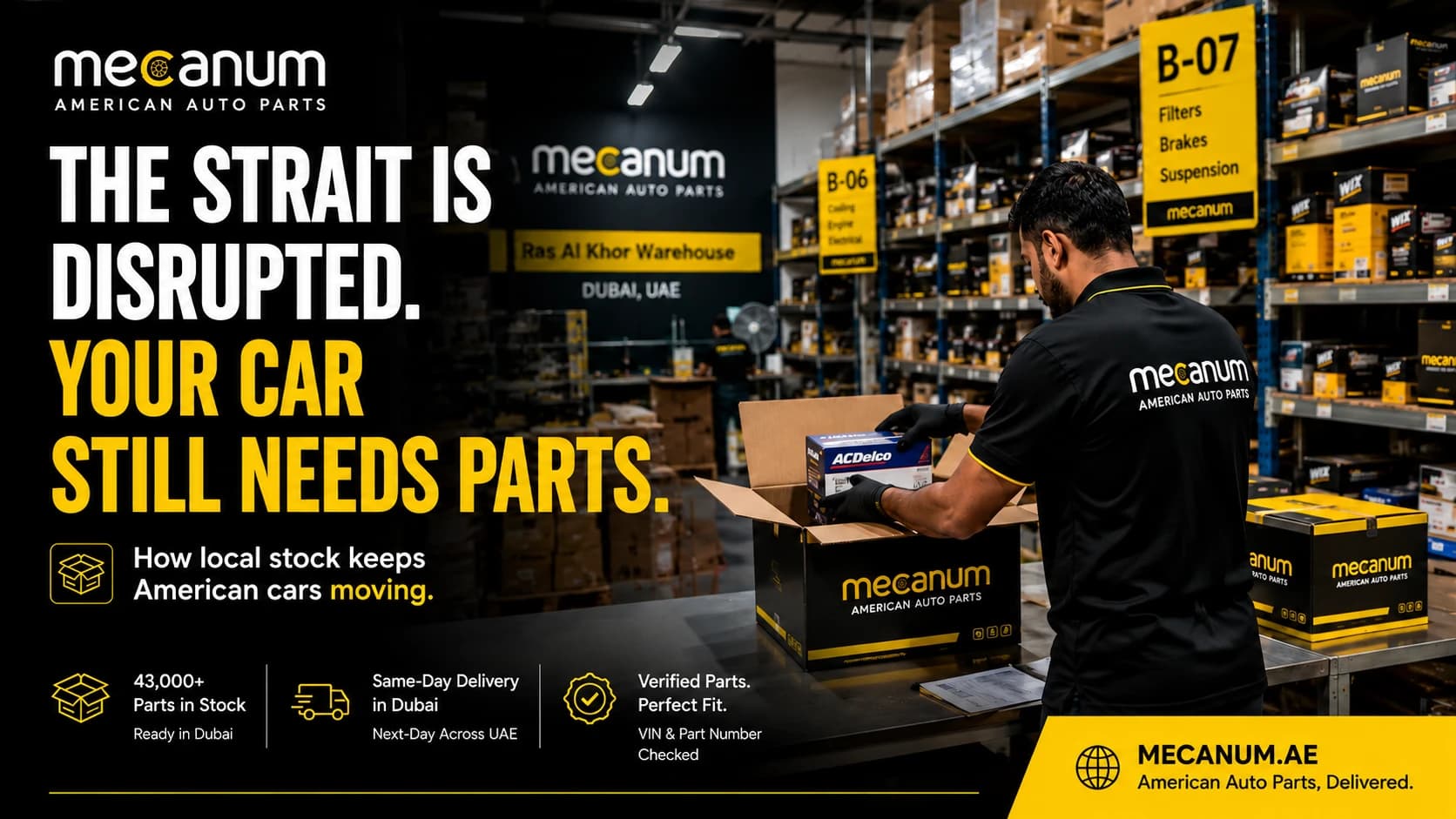
The Strait Is Disrupted. Your Car Still Needs Parts.
Published
The Night the Strait Closed
— And What It Means for Your Car Right Now
(Based on publicly reported events and carrier advisories, February–August 2026)
28 FEB–3 MAR 2026 | DUBAI · SHIPPING DISRUPTION
The disruption did not care about shipping schedules.
At the end of February 2026, Iranian missile and drone attacks reached the UAE as the wider regional conflict escalated. Dubai saw interceptions, fires and damage across transport infrastructure. On 1 March, debris from an intercepted missile sparked a fire at one berth at Jebel Ali Port — a critical gateway for cargo moving into and through the UAE.
The immediate effect on shipping was rapid. By 3 March, Hapag-Lloyd had suspended all vessel transits through the Strait of Hormuz until further notice, while services calling Gulf ports faced cancellations, delays and schedule changes. Other carriers introduced similar restrictions, surcharges and contingency routings as the security situation evolved.
At its narrowest point, the Strait of Hormuz is only about 33 kilometres wide. When traffic through it is restricted, the consequences reach far beyond energy markets: vessels wait, port calls change, insurance costs rise and Gulf-bound cargo becomes harder to plan.
Nobody in a Dubai workshop felt the full effect immediately. But any brake pads, engine mounts, filters or cooling-system parts still outside the UAE were suddenly facing a less predictable journey in.
The Ripple You Did Not Feel — Until You Did
01 MAR 2026 | JEBEL ALI, DUBAI · PORT OPERATIONS UNDER PRESSURE
Jebel Ali did not stop being a working port. Dubai authorities said the berth fire was caused by debris from an aerial interception, and DP World later confirmed that its Dubai container and general cargo terminals remained operational under enhanced safety and security measures.
What changed was the reliability of the wider shipping network serving the Gulf.
With Strait transits suspended and some Jebel Ali calls omitted, cargo schedules became harder to predict. Containers already in the region could still move, but incoming cargo faced booking stops, vessel omissions, alternative ports and longer end-to-end transit plans.
1 Mar
Jebel Ali berth fire reported after interception debris
3 Mar
Hapag-Lloyd suspended Hormuz vessel transits
$1,500
war-risk surcharge per TEU announced by Hapag-Lloyd
$3,500
surcharge per reefer or special-equipment container
For the UAE car-parts market, this was not an abstract logistics problem. It was the moment local, verified stock became even more important.
Any part that had not yet left a factory or overseas warehouse was now facing a less predictable and often more expensive journey to the UAE. The supply chain that normally worked quietly in the background had become a visible part of every sourcing decision.
The UAE aftermarket relies heavily on imported replacement parts. When Gulf shipping is disrupted, availability, lead times and landed costs can change quickly.
The Slow Emergency Nobody Announced
MARCH – APRIL 2026 · UAE AUTO PARTS MARKET · The effects arrive gradually
Supply-chain crises do not arrive like a wave. They arrive like a tide — slow, barely noticeable at first, then suddenly you are knee-deep and wondering when it happened.
Through March, the effects were uneven. Some parts remained readily available; others took longer to source, especially where suppliers relied on incoming shipments rather than local stock. The gap between 'yes, we can source it' and 'yes, it is physically here' suddenly mattered a lot more.
By early March, carriers had begun adding substantial risk and contingency charges. Hapag-Lloyd announced a war-risk surcharge of $1,500 per TEU for standard containers and $3,500 per reefer or special-equipment container, while other carriers introduced their own emergency charges. Suspended bookings, longer routings and alternative port arrangements added further time and cost.
The callbacks started.
'We can source it' is not the same as 'we have it on the shelf.' In a disrupted market, confirm stock, fitment and lead time before the car is taken apart.
Where Your Car Fits Into All of This
AUG 2026 | NOW · DUBAI · PEAK SUMMER
More than five months after the first weekend of the conflict, Gulf shipping remains disrupted and the Strait of Hormuz remains a live operational risk. Carriers continue to publish restrictions, surcharges and alternative delivery arrangements. The practical lesson for car owners is simple: local availability matters more when international lead times are uncertain.
For American-car owners in the UAE, this is the reality right now:
If your car needs a part
The question is not only 'who stocks this part?' but 'who can confirm it is physically in the UAE now?' If it has to come from overseas, lead time can change. A verified shelf part can move much faster once fitment is confirmed,
And UAE summer heat makes delay especially inconvenient. Cooling systems, belts, hoses, mounts, fluids and other wear items work hard in high temperatures. A marginal component that might have lasted longer in milder weather can become an urgent repair once summer stress exposes the weakness.
A supply-chain disruption and peak summer heat are a bad combination. If a component is already showing signs of wear, it is better to confirm the correct replacement and availability early than to wait until the car is off the road.
What Prepared Looks Like, Months Later
We want to be clear about what this means for Mecanum, because the moment calls for it.
No importer of car parts into the UAE is isolated from global shipping conditions. Incoming freight costs can rise, lead times can stretch and some routes can change with little notice. The difference is how much verified stock a supplier already holds locally — and how clearly they communicate when something needs sourcing.
What Mecanum built before this disruption, and what matters now, is a combination of three things: physical stock held in Dubai, multiple supply relationships, and the daily discipline of checking what is actually on the shelf before confirming an order.
Those habits were not created for this crisis. They are how we have always tried to operate: check the shelf, confirm fitment, give the real lead time, then dispatch.
If the part is already on our shelf in Ras Al Khor, it does not depend on the next vessel schedule. We can check it physically, confirm the fitment against your VIN or part details, and tell you the real availability before you commit
For the American marques we support, locally held stock is the stock that can help today. If a part needs sourcing, we tell you the actual lead time. If it is here, we can move it.
For replenishment, we continue to work across multiple supply channels and use alternative routing where it makes sense. Some inbound costs are higher than they were before the disruption, but the priority remains the same: keep stock moving and give customers a clear answer before they pay.
A Weekend at the End of February Changed the Supply Chain. Here Is What Has Not Changed.
The events that began at the end of February 2026 changed shipping routes, surcharges and lead-time expectations across the Gulf. For every UAE parts importer, sourcing became more complex.
It did not change the fact that your Silverado's brake pads still wear down. Your GMC Yukon's engine mount still ages. Your Ford F-150 still needs oil, coolant, filters, and the hundreds of other components that keep a truck running through a Dubai summer.
The Strait disruption is a supply-chain problem. It does not change what your car needs. The parts that are physically in Dubai can still be checked, matched and dispatched without waiting for an incoming vessel.
The Strait is disrupted. Your car still needs parts.
WhatsApp us your VIN/chassis number, part name or a photo. We will check the shelf, confirm fitment and tell you the price and lead time.
WhatsApp: +971 4 330 4022 | mecanum.ae